
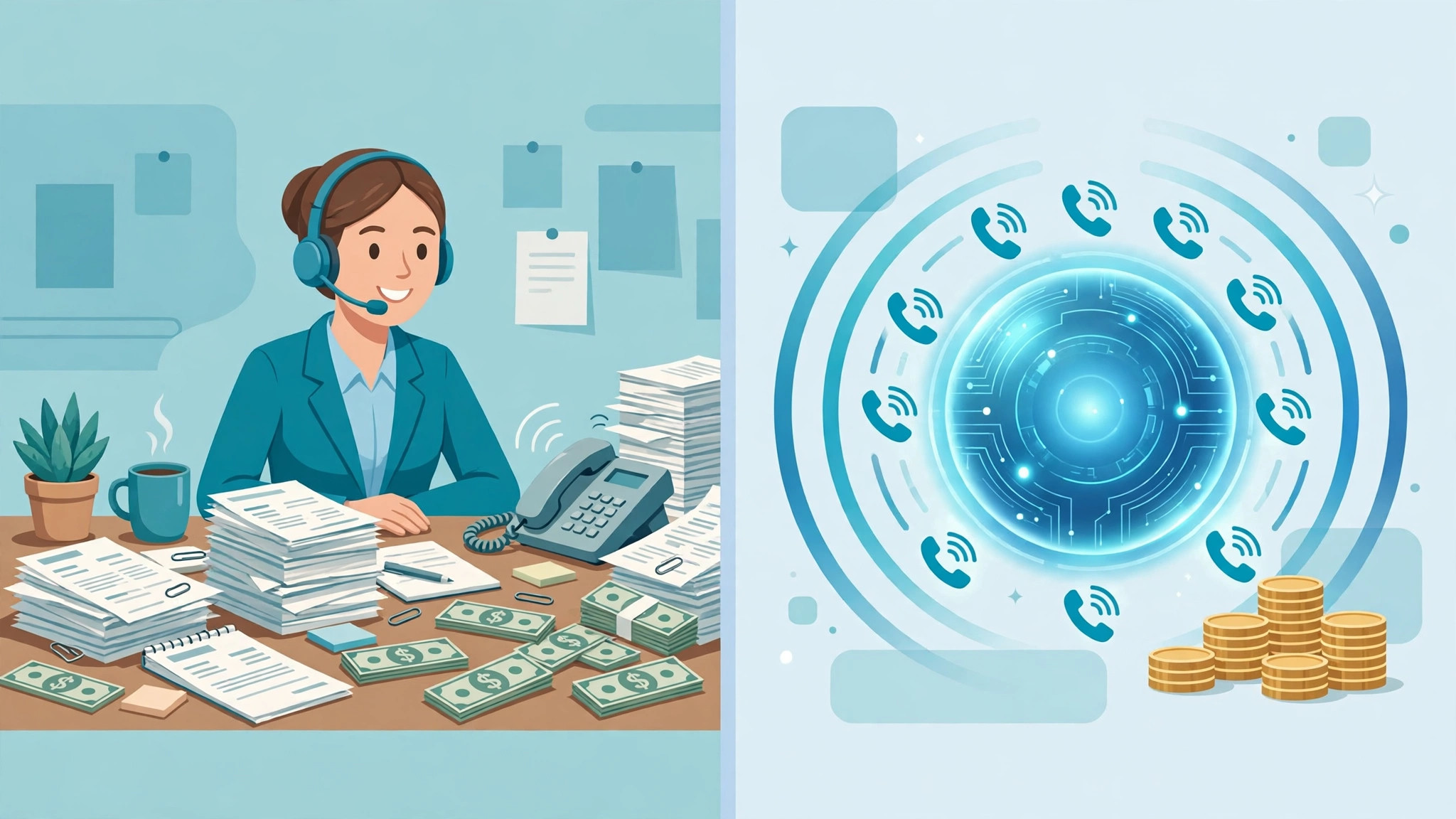
If you searched "ai receptionist vs virtual receptionist cost", you're probably stuck between two quotes that look nothing alike — and wondering which one is honest. This is the comparison we wish every small business owner had before signing anything: what each option really costs, how billing tricks inflate the bill, and which one actually fits your call volume. Every price range below comes from published vendor plans in 2026, and every estimate is labeled.
First: What Are You Actually Buying?
The words confuse people because "virtual" sounds like software. It isn't. Here's the plain-English split:
- Virtual receptionist: a real, trained human being answering your calls remotely — usually shared across several businesses, working from your script. You're buying a person's attention in minute-sized pieces.
- AI receptionist: software that answers, greets callers by name, answers FAQs, books appointments into your calendar, and transfers the calls that need you. No person involved until you want one.
- Answering service (the third cousin): a call center that mostly takes messages and emails you a summary. Cheaper than a virtual receptionist, thinner service.
The one question that cuts through every vendor's label: can it book an appointment during the call, without a human? If yes, it's a receptionist. If no, it's message-taking — whatever they call it.
The Real Price Ranges in 2026
From published plans tracked across roughly 30 providers this year:
| Option | Monthly cost (published plans) | How you're billed |
|---|---|---|
| AI receptionist (starter) | $25–$99/mo | Per call, per minute, or bundled minutes |
| AI receptionist (mid-range) | $99–$250/mo | Higher volume, CRM sync, custom voice |
| Human virtual receptionist | $200–$1,700+/mo | Per minute (minutes usually expire) |
| AI + human hybrid | $300–$2,000/mo | AI answers first, humans take over |
| Full-time in-house hire | $2,500–$4,000/mo [ESTIMATE] | Salary + benefits + overhead |
At the same call volume, AI typically costs roughly one-fifth to one-third of a human virtual receptionist service [ESTIMATE based on published plan ranges]. A human virtual receptionist like Ruby runs about $3.45 to $5.00 per receptionist minute on published plans — do the math on a 6-minute new-patient call and you see where the bill goes. We ran the same math against hiring for a small business in AI phone answering service cost vs hiring.
The Billing Model Matters More Than the Headline Price
Two plans at the same headline price can cost wildly different amounts depending on how your customers actually call:
- Per-call billing punishes short calls — every 40-second "are you open?" counts the same as a booking.
- Per-minute billing punishes long calls — a 12-minute insurance-verification call costs you triple a quick booking.
- Flat-rate billing is the only model where your bill is predictable. Budget for your busiest month, not your average one.
- Overages are the budget killer. Overage rates of 2x to 4x the in-plan rate are standard on human services, and on per-minute plans the minutes usually expire at month-end — unused coverage you paid for simply vanishes.
This is why a "$99/month" virtual receptionist plan can bill $300+ in a busy month, while a flat-rate AI plan stays exactly where it started. Before signing anything, ask one question: "What is my total bill if I have 30% more calls than average this month?"
The Capacity Difference Nobody Mentions
Cost per month is only half the arithmetic. The other half is capacity:
- One virtual receptionist = one call at a time. When your second line rings while the first is being answered, that caller waits or goes to voicemail. You're renting a single pair of hands.
- One AI receptionist = unlimited concurrent calls. Ten callers at 10:15 AM all get answered instantly, every one of them.
- Coverage hours differ too. Human services typically cover business hours or capped 24/7; AI is genuinely 24/7/365 at no extra cost.
For a dental practice or plumbing company, the 4:30–6 PM rush is exactly when a single human line chokes — and exactly when new-patient and emergency callers are deciding between you and the competitor. We mapped those peak-miss windows in our missed-calls playbook.
The Hidden Costs Checklist
Whatever quote you're holding, check for these before you compare:
- Setup fees: some AI plans carry a one-time setup charge — ask what "setup" actually includes.
- Contract lock-in: month-to-month vs. annual contracts change the risk equation completely.
- Message caps and transfer fees: some services charge extra to patch a call through to you.
- Turnover cost (hiring): a departing receptionist costs you recruiting time, training time, and weeks of rough caller experiences. An AI doesn't quit; an answering service can swap agents without you noticing.
- The "do nothing" cost: every missed call has a price — we did the full dental math in how much a missed call costs a dentist. One saved customer a month usually covers any of these plans [ESTIMATE].
When a Human Virtual Receptionist Is Worth the Premium
We'll be straight: a human still wins at anything requiring genuine empathy and judgment — the distraught patient, the complex legal intake, the caller who needs to feel heard, not processed. That's a smaller share of calls than most owners think, but it's not zero. Choose the human option when:
- Your callers are frequently emotional and the call itself is the service (counseling, funeral homes, sensitive legal matters).
- Your booking process has so many exceptions that a script can't cover them.
- Your brand promise is white-glove personal touch on every touchpoint.
Everything else — greetings, FAQs, scheduling, reminders, lead capture — is routine work that software now handles at one-fifth the cost.
The Bottom Line: Run Your Own Numbers
Pull your last three months of call data (total inbound, answered vs. missed, average call length) and run both options through it. For most small businesses paying $25–$300/month for an AI receptionist [ESTIMATE of the typical range], the payback is measured in days — one or two rescued after-hours callers cover the whole month.
And if you're not ready to commit, don't: test it on your real callers first. Our 14-day free pilot exists for exactly that — you keep your current setup, the AI covers the calls you'd otherwise miss, and you decide with your own data. No card, no contract.
Try a 14-Day Free Pilot — See Your Missed Calls
We'll answer your calls for 14 days, free, with no card required. You get a missed-call report showing exactly how many calls you'd have lost — then you decide.
📞 +1 (659) 399-015814-day FREE pilot · Hear a live demo first · Month-to-month